


Public schools are one of the largest food providers in the United States. Every day, millions of children walk into public school cafeterias expecting something simple: lunch.
For many students, that expectation is met. For others — vegan or vegetarian students, students with religious dietary needs, and the millions who are lactose intolerant — the cafeteria line can be a place of exclusion rather than nourishment.
That reality is why Jewish Vegan Life recently joined lawmakers, students, educators, and national advocates on Capitol Hill to spotlight the Plant-Powered School Meals Pilot Act—a bipartisan effort that could fundamentally reshape (for the better) what ends up on children’s plates.
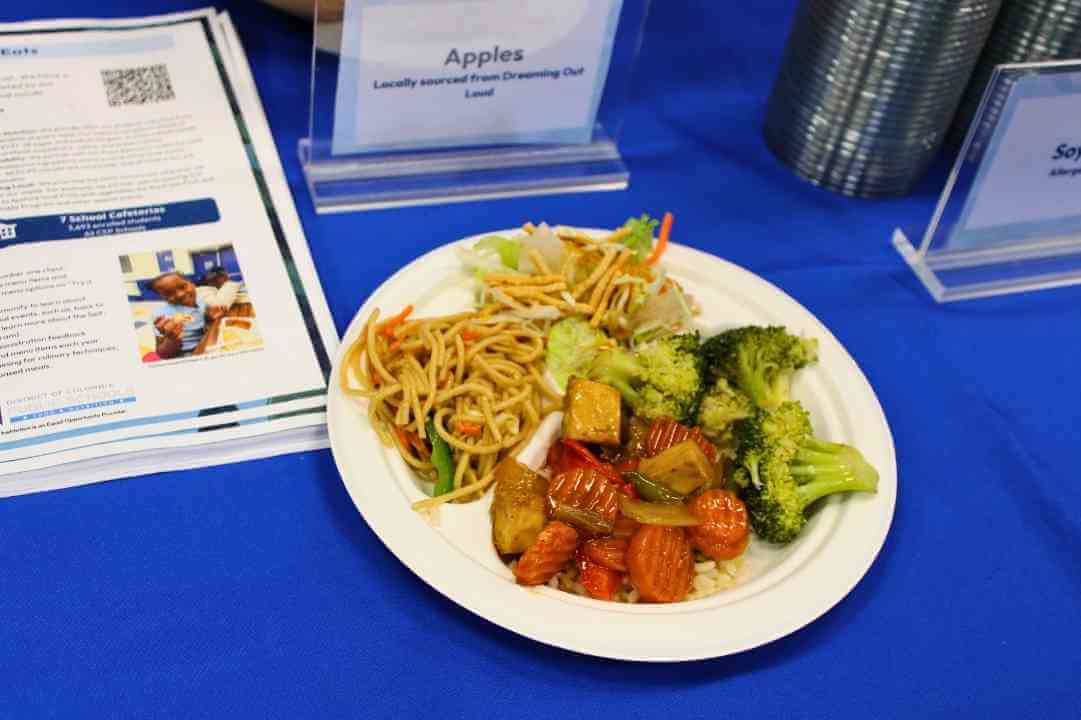
The event in the video above, hosted by Representative Nydia Velázquez in collaboration with the Plant-Powered School Meals Coalition, featured something powerful and symbolic: a delicious plant-based school meal prepared and served by DC Public Schools. It was more than tasty food, it was a policy moment.

A Policy Whose Time Has Come

The Plant-Powered School Meals Pilot Act, introduced in the House by Reps. Velázquez and Alma Adams and in the Senate by Sen. Adam Schiff, would establish a $10 million, three-year pilot grant program to help school districts expand plant-based entrée options.
Importantly, this legislation is not simply about swapping burgers for bean patties. It provides comprehensive support:
-
Culinary training and technical assistance for school food service staff
-
Funding for plant-based protein procurement from local and underserved producers
-
Student engagement initiatives like taste tests and nutrition education
-
Support for additional labor costs
-
Resources for menu development and kitchen needs
-
Expanded access to non-dairy milk
School districts serving high populations of low-income students would be prioritized.
This is what effective policy advocacy looks like: not symbolic resolutions, but practical tools that make change implementable.
As Senator Schiff stated when introducing the bill:
Providing additional resources to school districts so that they can provide more plant-based food options brings us a step closer to ensuring that all students can have access to healthy, sustainable meals.
The Human Reality Behind the Policy
Statistics matter. But stories move policy.

At the Capitol event, a student, Livia, shared her experience of entering high school and discovering there were no meals she could eat in the cafeteria.
Her family couldn’t consistently pack lunches. Between academic demands and dietary restrictions, she sometimes went through a 7½-hour school day surviving on black coffee, gum, and water. Headaches followed. Concentration suffered.
She wasn’t alone.
Vegetarian and vegan students, those with religious dietary needs, and lactose-intolerant students — including the 75% of Ashkenazi Jews who are lactose intolerant — often find themselves excluded from the “free and universal” meals promised to them.
After more than two years of student advocacy, her district finally introduced daily plant-based options. But it was, as Livia described, a grueling process, and district administrators cited lack of funding as the central barrier.
This is precisely why policy matters. Grants bridge the gap between intention and implementation.
A Model Already Working
Critics often ask whether plant-based school meals are realistic.
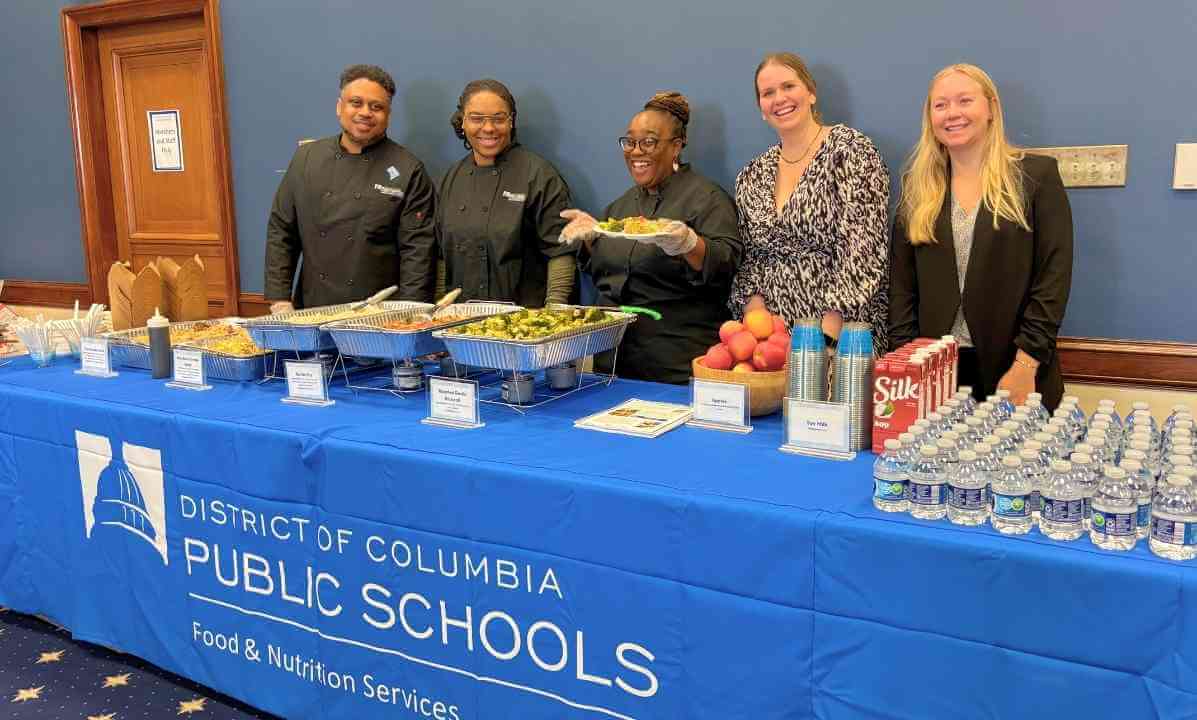
DC Public Schools has already answered that question. With a monthly “Try Tuesday” series, DCPS introduces plant-based recipes, trains kitchen staff, conducts student taste tests, gathers feedback, and integrates successful dishes into regular menus.
The district is on track to serve over 10 million meals this school year. As the DCPS official said at the event, “Feeding students is a sacred trust.”
Plant-based meals are not fringe offerings. They are increasingly popular across student populations — not only among those with dietary restrictions. When given thoughtfully prepared options, students choose them, and they love them. But training and funding are essential. Without resources, even well-intentioned districts struggle to make change sustainable.
A Major Legislative Win: Non-Dairy Milk Access
Advocacy does not always produce immediate victories, but persistence does. Congress recently passed the Whole Milk for Healthy Kids Act, which includes a landmark provision expanding access to nutritionally equivalent non-dairy milk in schools.
Previously, students could only receive plant-based milk if they provided a doctor’s note documenting a disability. Schools were not permitted simply to offer non-dairy milk broadly on the lunch line. This new law changes that.
Districts are now able to offer non-dairy milk options to any student as part of reimbursable meals. And they’re required to provide non-dairy milk upon parental request when a student has a disability, including lactose intolerance.
This is a significant equity breakthrough. The National Institutes of Health reports that the vast majority of Asian and American Indian Americans and between 50–80% of African Americans and Hispanic Americans are lactose intolerant. The Jewish community is no exception, we suffer from the same issue with dairy.
For years, millions of students faced structural barriers to accessing beverages compatible with their biology. A broad coalition — including Friends of the Earth U.S., the Physicians Committee for Responsible Medicine, Jewish Vegan Life, and other members of the Plant-Powered School Meals Coalition — are advocating for change. This win demonstrates that policy advocacy works.
Why School Food Policy Matters So Deeply
Public schools are among the largest institutional food purchasers in the country. What they buy influences agricultural markets, supply chains, student health outcomes, and the environmental impact of our taxpayer dollars. Plant-based meals are:
-
Linked to improved long-term cardiovascular and metabolic health
-
Associated with lower greenhouse gas emissions
-
Less resource-intensive than animal-based meals
-
More inclusive for diverse cultural and religious communities
-
Increasingly popular among students
Recent polling shows nearly 70% of Americans support children having access to nutritious plant-based beverages at school. When we talk about plant-based school meals, we are not talking about ideology. We are talking about:
-
Public health
-
Educational equity
-
Environmental responsibility
-
Fiscal pragmatism
-
Cultural inclusion
And increasingly, bipartisan momentum.
Jewish Values and Public Policy
For Jewish Vegan Life, advocacy on Capitol Hill is not merely political, it reflects our values. Jewish tradition emphasizes:
-
Protecting health (pikuach nefesh)
-
Preventing cruelty (tza’ar ba’alei chayim)
-
Stewardship of the earth (bal tashchit)
Ensuring that every child can eat safely and nutritiously in school is a direct expression of these values. Putting more vegan meals in our school system is good for the kids. It’s good for our community. It’s good for our world.

The Bigger Picture: Policy as Cultural Change
Policy does more than change menus. It signals what society values. When federal legislation funds plant-based meal pilots, it legitimizes innovation. It reduces stigma. It allows food service directors to act boldly without fearing budget shortfalls. It empowers students who have long felt invisible.
Most importantly, it recognizes that food policy is public health policy.
The Plant-Powered School Meals Pilot Act and the work of the Plant-Powered School Meals Coalition represents the next step forward, building on the non-dairy milk victory and expanding access to full plant-based entrées.
At the Capitol event Livia ended her testimony by saying that knowing food would be available to her each day brought security. And it ultimately brings dignity to the many students who deserve better from our school system.
From the lunch line to the Senate floor, the movement for plant-based school meals is proving that organized advocacy — rooted in compassion, science, and equity — can reshape national systems. And this is only the beginning.
The Time to Act is Now
School food policy may not dominate headlines. But it shapes daily reality for millions of children. Ensuring inclusive, nutritious, plant-forward options in public schools is:
-
A public health investment.
-
An equity commitment.
-
An environmental strategy.
-
A reflection of Jewish values and responsibility.
Members of the Jewish community — and all who care about children’s health and dignity — should urge their representatives to support the Plant-Powered School Meals Pilot Act and continued expansion of vegan food in schools. Take action today:
- Contact your U.S. Representative and Senators and urge them to support the Plant-Powered School Meals Pilot Act.
- Ask your local school district about plant-based entrée options and non-dairy milk access.
- Encourage Jewish institutions and synagogues to educate congregants about inclusive plant-based school food policy.
- Share this article to spark conversation about how school lunch connects to health, equity, and Jewish values.
Because no student should have to choose between hunger and exclusion. And no society should ignore a solution that nourishes its children while protecting its future.