


Rosh Hashanah LaBehemah Was Forgotten for Two Thousand Years. This Elul, Thousands of Jews Brought It Back Transformed.
Most people know Rosh Hashanah. Fewer know that the Jewish calendar holds four new years, not one. The Mishnah names them plainly: the new year from the Torah, the new year we call Rosh Hashanah, a new year for trees, and a new year for animals, observed on the first day of Elul. Of the four, that last one all but disappeared. It had no shofar, no seder plate, no place in most people’s Jewish education. For close to two thousand years, it sat quietly in the text, waiting.
But it will sit quiet no longer. Jewish Vegan Life brought the New Year for Animals back into the world in a totally new way through a global livestream and five in-person celebrations across North America and Israel. Thousands of people took part across all the celebrations, including the global livestream, the dinner in DC, the Montreal picnic, the gourmet seder in Los Angeles, the vegan potluck in Jerusalem, and in a first of its kind full Haggadah seder in Pittsburgh that had never before existed in Jewish life. What began as a single forgotten line in the Mishnah became a working model for how the entire Jewish world could mark this holiday going forward.
The Season Opens
The campaign opened on August 9 with three celebrations at once, spanning three time zones and, in the case of the livestream, six.
That global broadcast, Healing the World Through Compassion: A New Year for Animals, gathered voices from across Jewish life and the animal protection movement for a conversation moderated by JVL CEO Raquela Karamson. Bruce Friedrich, founder and president of The Good Food Institute, spoke to how food innovation is reshaping what compassion can look like on our plates. Adit Romano, co founder of Freedom Farm in Israel, spoke from her years spent helping people meet rescued animals as individuals rather than abstractions. Arash Yomtobian, president and CEO of Mercy For Animals and an ethical Jewish vegan of nine years, brought two decades of organizational leadership to the question of what it takes to end factory farming. And Rabbi David Rosen, a member of JVL’s Spiritual Council and former Chief Rabbi of Ireland, grounded the conversation in the same Torah that has carried this holiday for millennia. Thousands watched from multiple continents.

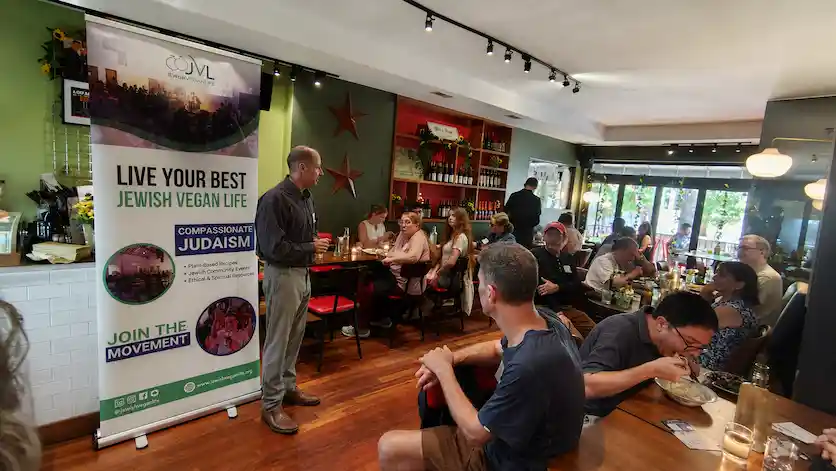
While the livestream was reaching a global audience, the JVL DC Tikkun Circle was gathering closer to the ground, over dinner in a vegan restaurant. Partnering with the Veg Society of DC and DC Voters for Animals, the evening offered exactly what a Tikkun Circle is built to offer: a table, a shared plant based meal, and real conversation about what Jewish tradition asks of us when it comes to the animals in our care. People learned about the holiday, about Jewish thinking on compassion for animals, and shared their food journeys.
In Montreal, the JVL Tikkun Circle marked the day differently still, with a picnic in Mount Royal Park. Rabbi Boris Dolin of Congregation Dorshei Emet, JVL Montreal’s spiritual leader, offered reflections on the holiday’s meaning as pets joined the gathering. Vegan pizza sat next to homemade dishes, demonstrating ways to enjoy favorite dishes while avoiding harm to animals. It was, in its way, as complete an expression of the holiday’s spirit as the livestream reaching thousands, just built at the scale of a neighborhood park instead of a broadcast.

Four Days Later
On August 13, the official evening of the new year, the season reached its most ambitious moment.
In Los Angeles, Rabbi Jonathan Bernhard led a New Year for Animals Celebration dinner built around a chef-prepared, multi-course vegan dinner and a moving speech that put people on cloud 9. It was elevated and intentional, the kind of evening built to show longtime members of the Jewish community what this holiday could become in their own synagogues.

In Jerusalem, Jewish Vegan Life partnered with Animals Now and Ginger for a vegan potluck, bringing the community together over this shared holiday. It was one of the most meaningful gatherings held in the city where the practice of tithing flocks for this holiday first took shape thousands of years ago.

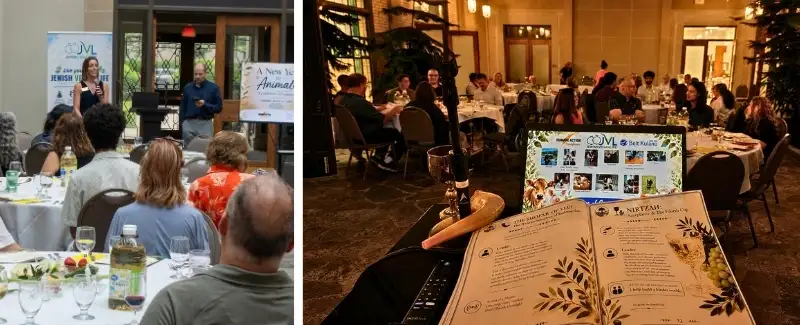
And in Pittsburgh, something happened that had no precedent in Jewish history. At Beit Kulanu, the largest synagogue in the region, in partnership with Humane Action Pennsylvania, the community gathered for a full length New Year for Animals seder, the first ever held. Built around four movements of spiritual transformation and grounded in original liturgy using JVL’s new Haggadah, the evening moved participants through ancient text, embodied ritual, and a gourmet plant based feast. It was designed so that people would not simply learn about compassion, but feel their way into it over the course of the night. What had been theory in the Mishnah became, for one evening, lived practice.
A Holiday Ready for the Calendar
Taken together, these six gatherings prove something that could not have been proven any other way: this holiday works, at every scale and in every format a Jewish community might reach for. A restaurant-sized dinner in DC. A park picnic in Montreal. A gourmet multi-course evening in Los Angeles. A grassroots potluck in Jerusalem. A full ritual experience in Pittsburgh. A global broadcast reaching thousands who could not travel anywhere at all. No community is too small, too casual, or too resource limited to hold its own New Year for Animals. The models already exist, tested this Elul by real people who showed up to make this possible.
Rosh Hashanah LaBehemah is not a new addition to Jewish life. It has been sitting in the Mishnah since before most of the customs we now take for granted existed. What’s happening now is a transformation of this holiday for the modern era, focused on care for all Creation. This holiday now has a track record across cities and continents, with a complete Haggadah proven capable of carrying a full congregation through the night.
The circle of compassion this holiday asks us to expand does not close when Elul ends. The invitation now goes out to every rabbi, every Hillel, every JCC, and every community that has never marked this day: the fourth Jewish new year is an invitation to reimagine our relationship with animals. Next Elul, it can be yours too.