
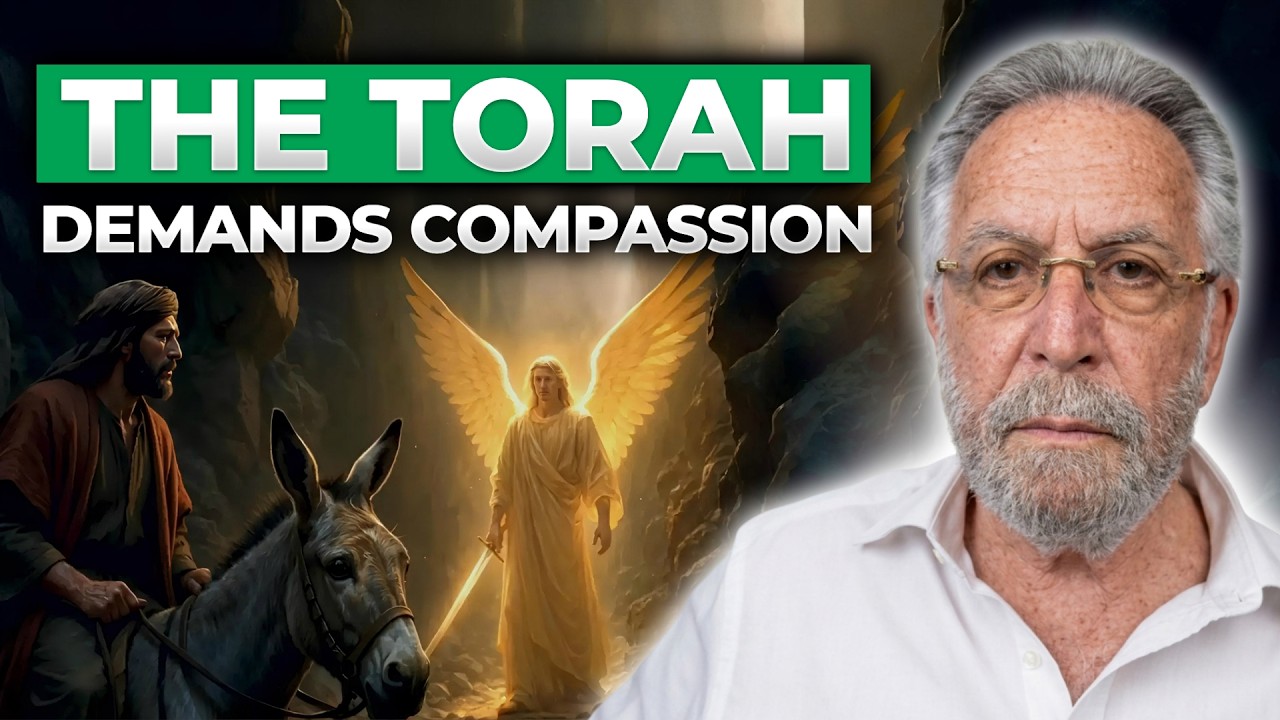


The parshah named after Balak, king of Moab, is ostensibly about a failed curse. Balak wants Balaam, a gentile soothsayer/prophet, to curse the children of Israel and God intervenes at every turn to prevent it. But perhaps the most remarkable episode in the story concerns a donkey.
A Prophet Who Could Not See
Balaam, on his way, apparently hoping to do Balak’s bidding, cannot see the angel of the Lord standing in his path with a drawn sword. His donkey can. The animal moves off the road, presses against a wall, crushes Balaam’s leg, and finally sits down entirely. Balaam strikes the donkey each time. And then the donkey speaks: “Why have you struck me these three times? Am I not your loyal donkey who has served you all these years?”
The angel confirms the charge: “Why did you strike your donkey these three times?”
For Maimonides, this moment is not merely a dramatic curiosity. It is the textual source for the Torah’s prohibition against cruelty to animals, tza’ar ba’alei chayim. From a donkey’s rebuke springs one of the foundational ethical principles of our tradition.
A Tradition Built on Compassion
In my encounters with other religions I am often struck by the fact that while all spiritual traditions have so much to say about compassion for human beings, many often have little to say about our obligations to the animal world. However, the Torah instituted protections for animals thousands of years before the first societies for the prevention of cruelty to animals were conceived. Maimonides understood these protections as expressions of care for sentient beings who feel pain and suffering, and who therefore make a moral claim on us. Nachmanides took a different view, insisting that these commandments exist primarily to refine our own moral character. But the two positions arrive at the same place: cruelty to animals is sinful, and compassion toward them is a Jewish imperative.
Our sages were not speaking metaphorically. God is described in our tradition as the Merciful One. Psalm 145, which we recite at least three times daily, declares that God is merciful to all his creatures, and Judaism teaches that we are commanded to emulate the Divine Attributes. In the words of the sage Abba Shaul: “Just as He is gracious and merciful, so you be gracious and merciful.” The rabbis went so far as to identify compassion as the defining characteristic of the Jewish people, and to say of someone entirely without it that their very lineage might be questioned.
Both Moses and David were considered worthy of leadership, our tradition tells us, precisely because of the tenderness they showed toward the animals in their charge. When Abraham’s servant went to find a wife for Isaac, the quality he sought and found in Rebecca was exactly this: compassion toward both humans and animals. The Talmud even records that Rabbi Yehuda HaNasi received divine punishment for refusing to shelter a frightened calf seeking his protection on the way to slaughter.
What I Saw in the Slaughterhouse
I came to veganism slowly. When I was serving on the Beit Din in Cape Town, my duties required me to visit slaughterhouses and inspect the knives of the shochetim. What I saw I found horrific. I felt I could not benefit from something I recoiled from even thinking of doing. I also discovered the extent of cruelty in the livestock industry — far more than could have ever been conceived of in the past — and which I could not reconcile with Jewish teaching. It took longer than it should have for me to fully understand that the dairy and egg industries presented the same moral problem. But the conclusion, when I arrived at it, was not complicated: a tradition that identifies compassion as its defining characteristic cannot make its peace with an industry built on systematic cruelty.
A Chillul Hashem
And that is precisely what the modern factory farming system is. Millions of sentient creatures are raised in conditions of chronic suffering, killed for human indulgence. Many of the greatest authorities in our tradition, among them R. Joseph Albo, the Abravanel, the Akedat Yitzhak, the Kli Yakar, Rav Kook, and Rabbi J.B. Soloveitchik, understood the Torah’s permission to consume animals as a concession to human weakness, not an endorsement of it. The laws of kashrut, as the rabbis of the Midrash understood them, were designed to refine us and draw us away from carnivorous habits toward a more ethical relationship with creation.
To describe the products of factory farming as kosher is a chillul Hashem, a desecration of the Divine Name, as it presents Torah as something that can legitimately partner with cruelty, with environmental devastation, with the systematic suffering of creatures.
Are We Willing to See?
Balaam could not see the angel his donkey saw. The angel had to speak through the donkey’s voice before he would understand. Perhaps the question this parshah puts to us is whether we are willing to see what is standing in front of us, or whether we too require a donkey to stop us in our tracks.
A plant-based diet is not an eccentricity or a personal preference. It is the most direct path available to ensure that our daily choices do not make us party to the violation of our own most cherished values. The Psalmist tells us that God’s mercies are upon all his creatures. So must ours be.